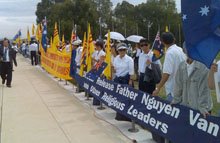
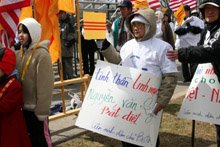
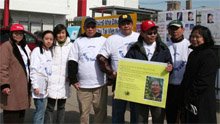
History

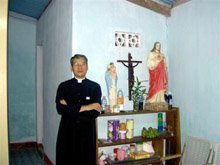
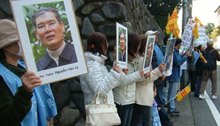
Father Thaddeus Nguyen Van Ly is a Roman Catholic priest and prominent Vietnamese dissident involved in many pro-democracy movements. Father Ly has already spent around 15 years in prison for peacefully criticizing government policies on religion and advocating for greater respect for human rights since the late 1970’s. For his ongoing imprisonment and continuous non-violent protest, Amnesty International has adopted Nguyen Van Ly in December, 1983 as a Prisoner of conscience. In November, 2000, Nguyen Van Ly gained global and official attention, when members of the Committee for Religious Freedom visited Nguyen Van Ly in his village, during US president Clinton's visit to Vietnam but he was sentenced again in October 2001 to 15 years in prison for activities linked to the defence of free speech. The sentence was later reduced several times and he was finally released in February 2004. Most recently, his support for the Bloc 8406 manifesto has led to his sentence on March 30, 2007 for an additional eight years in prison. Read full biography

Saturday, April 21, 2007

Let’s speak up for dissent in Vietnam State muzzling of priest/poet an outrage that ought to be challenged

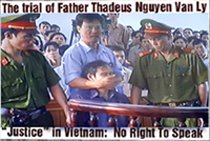
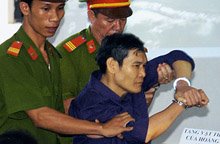
During the trial on March 30, Father Ly Van Nguyen’s mouth was physically muzzled after he recited four lines of his own poetry.``Communist trial of Vietnam / A lewd comedy for years / Jurors a bunch of baboons / Servants of dictators, who are you to judge?’’International human rights groups condemned the sentencing, which took only five minutes without a defense lawyer. ``This sentence means Father Ly will be a prisoner of conscience for the fourth time in two decades,’’ noted Amnesty International’s Deputy Asia Pacific Director, Tim Parritt. ``It is indicative of a broader crackdown on dissent by the Vietnamese authorities that has been intensifying since the country held the APEC (Asia-Pacific Economic Cooperation) meeting last November.’’

Vietnam intermittently plays a cat-and-mouse game with its political dissidents, arresting and releasing its most famous activists while those less visible are disappeared. Since March, however, Vietnam has launched one of the worst attacks on dissidents in 20 years. Among those arrested with Father Ly were Nguyen Van Dai and Le Thi Cong Nhan. All three were charged with carrying out propaganda against the Socialist Republic of Vietnam, under article 88 of the Penal Code.

If convicted, Le and Dai face sentences of up to 20 years in prison.

The arrest and subsequent disappearance of lawyers Le Quoc Quan and Tran Thuy Trang, however, are particularly alarming. Both are well known. After returning from a fellowship at the National Endowment for Democracy in the United States, Quan was arrested March 8 and charged with attempting to overthrow the Hanoi regime. The day before, Trang, another young lawyer in Ho Chi Minh City, was reportedly arrested by 60 security police. She has not been heard from since. According to Human Rights Watch, Trang’s family was forced to sign documents promising not to discuss the arrest.

Speculation abounds. Why now? Vietnam, after all, has been granted membership in the World Trade Organization and made its entrance to the world’s economic stage last November when it hosted its first Asia Pacific Economic Cooperation conference. Its gross national product has been growing at a steady and impressive 7 percent for the last several years, and while political dissent is not allowed, its population is experiencing far more personal freedoms than during the cold war. Many are allowed to travel overseas. Private capitalism is all the rage. Movement within Vietnam is permitted freely. There’s a middle class with disposable income and access to the Internet. Vietnamese media, too, while still controlled by the state, have proliferated and some have been pushing the envelope to cover stories of corruption and even official wrongdoings.

Perhaps that’s precisely why, at least in the eye of the ruling communist elites, the crackdown seems to be needed: to maintain absolute political power. Political movements are brewing along with an increasingly wealthy and educated population, especially now that the population is growing more sophisticated and politically aware. Voices of dissent are heard daily, if not on the op-ed pages, then at least on the streets.

Nguyen Van Dai, an outspoken dissident, is one of a handful of practicing human rights lawyers in Vietnam. He founded the Committee for Human Rights in Vietnam in 2006 and was recently awarded the prestigious Hellman/Hammett prize for persecuted writers. Father Ly is a co-founder of Bloc 8406 — a political movement that made its entrance to Vietnam’s public stage on April 8, 2006, when it published "Manifesto for Freedom and Democracy." Two days earlier, it had issued an "Appeal for Freedom of Political Association."

These documents boldly challenged the Vietnamese government to uphold individuals’ rights to free expression, association and participation in political affairs.
Hanoi swiftly retaliated against both.

"Several key organizers of Bloc 8406 and their families have been harassed and imprisoned, showing that the Vietnamese government is still trying to silence its critics," noted Sophie Richardson, deputy Asia director for Human Rights Watch. "Targeting the most vocal, visible activists sends a message to the others: Don’t speak out, or you’ll suffer the same fate."

If Hanoi was hesitant to act before President Bush’s visit during the APEC meeting last November, it was not afterward. For a president who touted "freedom" and "democracy" in the Middle East, Bush came bearing an unexpected gift — a license, as it were — for the government to use against its dissidents.

Though the U.S. president originally had hoped to give Vietnam normal trading status, that deal was delayed in Congress. Embarrassed by having no gift in hand, he dropped Vietnam from the list of nations that severely curtail religious freedom instead, even as these violations continued unabated.

The widely published photo of Bush smiling amicably under the bust of Ho Chi Minh augured terribly bad feng shui for Vietnamese human rights activists. It clashed with images of heavily guarded homes of political dissidents just a few kilometers from the APEC meeting in Hanoi.
Freedom and democracy, apparently, were far from Bush’s mind in Vietnam.

The United States once served as the bright and shiny model of democracy for many in Vietnam. But no longer.

Since Bush’s visit, the list of those arrested has grown. Nguyen Tan Hoanh, Doan Van Dien, Doan Huy Chuong, Tran Thi Le Hong, Le Ba Triet and Nguyen Tuan are among hundreds of political and religious prisoners in Vietnam, including cyber-dissident Nguyen Vu Binh, at least nine members of the Cao Dai religion, 10 Hoa Hao Buddhists and more than 350 ethnic minority Christian "Montagnards" from the Central Highlands.

In Vietnam, the word censorship is the colloquial phrase — bich mien — to cover the mouth. The picture of Father Ly’s muzzling seems a literal enactment of an old cliché. But in the old days, his image wouldn’t have gotten out of the country so quickly or circulated so widely, nor would his voice be heard at all. Back then, before the Cold War ended, he would have disappeared without a trace.

The wind of change seems to be on the dissidents’ side. Thanks to high-tech communications such as the Internet, cell phones and satellite dishes, and increasing interactions with foreigners, Vietnam has a more informed, and therefore, increasingly restless, citizenry.

The Vietnamese word for leader — lanh dao — literally means "bearer of the truth (or the way)." Such leadership is non-existent among communist party leaders since Ho Chi Minh. These days, the carriers of the dao are identified with dissidents like Father Nguyen Van Ly and human rights lawyers like Nguyen Van Dai and Le Thi Cong Nhan, prisoners of conscience with fearless spirit and indomitable strength.

And so, if one were to peel away the policeman’s hand from Father Ly’s mouth, the rest of his poem may go something like this: "You can cover our mouths, blind our eyes / We will still speak, and see / Your rotten ideology is at an end / Your cruelty the sign of weakness / Change is coming! Change is coming! / And we, the people, will be free."

Lam is editor of New America Media and author of ``Perfume Dreams: Reflections on the Vietnamese Diaspora.’’

RIGHTS ABUSES IN VIETNAM: Outcry Over Sentencing of Vietnamese Catholic Priest Prompts Resolution from U.S. Congress

The U.S. Congress has entered the fray involving what one congressman has called the "kangaroo court conviction" of Father Nguyen Van Ly, a Vietnamese Roman Catholic priest by the Hanoi regime.

A resolution authored by U.S. Rep. Chris Smith, R-NJ, calling for substantial human rights reforms in Vietnam was overwhelming approved this week by the House Foreign Affairs Committee during their first mark-up since Vietnam’s conviction of Father Ly.

Earlier this year, the parish house of Father Ly — a former prisoner of conscience who spent more than 13 years in prison — was raided. Father Ly was moved to a remote location and placed under house arrest. Father Ly is an advisor to "Block 8406" - a democracy movement which started last April - and a new political party, the Vietnam Progression Party.
On March 30, 2007, Father Ly was sentenced to 8 years in prison for distributing "anti-government" materials.

Father Ly was among a number of dissidents swept up in a recent crackdown in Vietnam. In March, Vietnamese police arrested another member of "Block 8406," principal spokesperson for the Vietnam Progression Party and the founder of the Vietnamese Labor Movement, Le Thi Cong Nhan. On the same day — March 6, 2007 — Vietnamese police arrested one of Vietnam’s few practicing human rights lawyers, Nguyen Van Dai.

"Father Ly’s sham trial proves once again that the regime in Hanoi is not committed to the human rights reforms they promised as a precondition for normalized trade relations. It is not enough for the Government of Vietnam to talk reform — they must also show progress through their deeds," said Smith, who actively opposed the granting of normal trade relations with Vietnam.

Smith added: "Recent government actions show that Vietnam is moving backwards, not forward. This resolution reinforces our unwavering commitment to human rights reform in Vietnam and demands that the regime in Hanoi cease their persecution of dissidents."
"There is no compromise, no halfway point when it comes to basic human rights. We must send a clear message to the Government of Vietnam that there is no place in modern society for their conduct," Smith said.

Introduced last month, Smith’s resolution (H.Res. 243) calls on the Government of the Socialist Republic of Vietnam to immediately and unconditionally release political prisoners and prisoners of conscience, including Father Ly and those who have been arrested in a recent wave of government oppression. The resolution also calls for the Government of Vietnam to comply with internationally recognized standards for basic freedoms and human rights.

"I have met with Father Ly and a number of other dissidents who are now behind bars or under constant surveillance and harassment in Vietnam. The bullies in Hanoi continue their systematic and brutal politically motivated crackdown on democratic activists and this must end," Smith said.

"Father Ly’s arrest and conviction are purely political, a shameful attempt to silence him and intimidate anyone else who dares to speak out against the government. We have an obligation to speak up for Father Ly and other dissidents who are persecuted in Vietnam. Now that the Committee has spoken through this resolution, it is time for the full House to immediately pass it and give a voice to the dissidents in Vietnam," Smith added.

A similar Smith-authored resolution condemning human rights abuses in Vietnam and calling on the Government of Vietnam to release political prisoners passed the U.S. House of Representatives in 2006.

In another development affecting Protestant denominations in Vietnam following the March 29, 2007 sentencing of Ly to 8 years in prison for distributing "material harmful to the state," two Protestant lawyers charged with the same "crime" are expected to face equally harsh sentences in what Human Rights Watch has called the harshest crackdown in 20 years.
Attorney Nguyen Van Dai, 38, a member of the main Hanoi congregation of the legally-recognized Evangelical Church of Vietnam (North), or ECVN (N), since 2000, was arrested on March 2, 2007.

He had been documenting human rights violations in Vietnam.
According to Pastor Au Quang Vinh of the Hanoi church, a second lawyer, Le This Cong Nhan, 27, was also arrested in early March. She had just completed a doctrine course for new believers at the same church in preparation for baptism.

Both lawyers also have friends among Vietnam’s house churches. Dai is also a member of Advocates International, an organization which brings together Christian human rights lawyers from many countries.

Authorities have prohibited Dai’s wife, Khanh, from visiting him, and her home phone and cell phone services have been cut. A Christian source also said that police have been trying to incite neighbors against her.

An 80-year-old lawyer, Tran Lam of Hai Phong, is willing to defend Dai, but contrary to Vietnamese law, police will not allow him to have contact with Dai, sources said. They added that authorities prohibited Dai from taking his Bible or some of his medications with him.
Following the arrests of Dai and Nhan, Vietnam’s official press painted the two lawyers in unflattering terms. On March 14 and 17, the An Ninh The Gioi (World Security) newspaper, official organ of the Ministry of Public Security, carried a four-page, two-part article showing the government’s view of the two lawyers and the case against them.

Both lawyers are described in the state-controlled newspapers as very average individuals who could not hold a job after graduation from law school. Revealing more than intended, the article describes Dai getting into law school without sufficient grades because of his father’s influence as a Communist Party member.

The report paints both lawyers as criminals. Dai is said to have received a U.S. State Department scholarship to study advocacy in the United States and to have later helped to study Internet and computer security in the Philippines. He is accused of distributing "alleged infractions of religious liberty" to Vietnam’s enemies aboard.
Nhan is accused of assisting in the establishment of an "independent trade union." Both are accused of fraternizing with other dissidents in the country and with counter-revolutionary exiles abroad. Both are accused of teaching students and other young lawyers "the values of Western human rights."

They are also accused of involvement in a pro-democracy movement called Bloc 8406, begun a year ago. Roman Catholic priest Father Ly has been accused of helping to found Bloc 8406. Ly, 60, who had been under house arrest since February, has spent 14 of the past 24 years in prison.

Dai is accused in the article of getting money from counter-revolutionary exiles abroad and of stealing US $80,000 from the ECVN (N). Church leaders told Compass that they were not aware of any such money.

Dai’s activities in human rights advocacy, beyond religious freedom, have become controversial in Vietnam’s evangelical community. Many Vietnamese Protestants believe it is too risky to challenge the political monopoly of the state in such matters. Some are even willing to pay the high price of silence on other human rights in exchange for supposed improvements in religious freedom.

The ECVN (N) leadership reportedly indicates some reservations about Dai’s dissident activities. In an apparent leak to the government of a copy of its executive committee minutes of June 6, 2006, the An Ninh The Gioi article says the church committee moved to remove Dai from the church’s legal committee for fear that his involvement in human rights work would "damage the reputation of the church."

The official newspaper article tries to inextricably link together Dai, the ECVN (N) and the U.S. government, in keeping with the long-held fear by Vietnam’s authorities of "peaceful evolution." In this paradigm, Vietnam says that after its erstwhile enemies lost the war in 1975, they have then turned to "democracy, human rights and religious freedom" to try to overthrow the communist revolution. All three factors have been invoked to justify the crackdown.

The U.S. State Department, which strongly defended removal of Vietnam from its list of the worst religious liberty violators last November, has been witness to some recent events that could evoke second thoughts. U.S. Ambassador to Vietnam Michael Marine recently spoke diplomatically about the crackdown and the rights of Vietnam’s citizens to engage in peaceful expression of their views on human rights and political matters – but then things turned nasty.
On April 6, 2007, the ambassador invited the wives of four imprisoned dissidents, including Dai’s wife, as well as the mother of Nhan, to a reception at his home in Hanoi to meet U.S. Congressional representatives. The police prevented three of the women from even leaving their neighborhoods and stopped the other two women with a large police contingent outside the ambassador’s home.

According to a report from The Associated Press from Hanoi on April 6, the usually conciliatory ambassador complained strongly about this to Vietnamese Deputy Prime Minister and Foreign Minister Phan Gia Khiem.

"You had 15 men surrounding two women, speaking in loud voices and grabbing their upper arms and tugging them," Marine reportedly said. "I told them it was absolutely wrong for women anywhere to be treated that way."

A long-time Vietnam observer remarked, "People may have growing freedom to ’believe,’ but when Christian-motivated activists act on their belief that the dignity of humankind leads to inalienable human rights, they are still prosecuted in the Socialist Republic of Vietnam, where peaceful human right advocacy is considered a criminal offense."

The Vietnamese Assemblies of God house churches first called on Dai in 1999 to try to use legal means to fight the arrest of a house church leader, Mrs. Nguyen Thi Thuy, in Vinh Phu Province. That appeal was unsuccessful, but Dai became a believer through the Christian contacts he met in the process.

Shortly after, Dai and his wife became active at the Hanoi Evangelical Church at 2 Ngo Tram Street.

Dai gained notoriety among authorities in Vietnam and some recognition abroad for his defense of "the Mennonite six" in 2004 and 2005, a case he lost in spite of superior arguments due to the lack of an independent judiciary in Vietnam. Two of the six accused Mennonites, however, were released before the end of their sentences because of strong international advocacy.
Nhan, recruited by Dai into his law firm, became a Christian in 2006. She and her mother had been Baha’i believers but were expelled for "going against Baha’i beliefs and doctrine." Nhan was supposed to be baptized this past Easter.

Friday, April 20, 2007

Jailed Vietnamese priest accepts suffering as witness to Catholic faith, brother says

PERTH, Australia (CNS) – A Vietnamese priest sentenced to jail for spreading propaganda has accepted his suffering as an opportunity to bear witness to Catholicism, said his older brother.
"He has said that going to jail, for him, is a chance to convert people and baptize them," said Nguyen Hoang An of his brother, Father Thadeus Nguyen Van Ly.

Vietnamese prisons do not allow inmates to be visited by priests, An told The Record, the weekly newspaper of the Archdiocese of Perth, through an interpreter. An has lived in Australia since 1983 but speaks little English. An said that during Father Ly’s long years in jail he has converted many prisoners and prison guards to the Catholic faith.

Prison authorities will not speak with Father Ly in his cell, where all conversations are filmed and recorded on tape. Instead they summon Father Ly to a meeting in the open air, where their words cannot be monitored by Communist Party officials, An said.

Father Ly, who has already spent 14 years in Vietnamese prisons – much of it in solitary confinement, was recently sentenced to eight more years in jail. Father Ly and four pro-democracy lay Catholic activists were jailed after speaking against Vietnam’s one-party government.

Though there has been speculation about the mental effect such intense incarceration might have had on Father Ly, An said his brother is mentally strong and that his frequent prayer to God while in jail acts as a preventative against mental deterioration.

An said he did not believe that his brother would be subjected to torture in his current imprisonment, but he said torture has been a regular feature of the prison system in Vietnam.
An, who has spent time in prison, described the psychological and physical tortures used for decades on ordinary, noncriminal Vietnamese who have run afoul of the communist regime.
"They torture you in many ways," he said. "They use two lights, very bright, and you have to look into it. Soon your brain goes blank. They don’t let you eat.

"They make you stand with your hands on the wall, and if you happen to kneel down or drop that pose, they will hit you," he said. "And in the heat, in the sun, they will make you stand to the flagpole. You have to stand and look at the flag and when you’re too tired, when you fall down, they will hit you and make you stand up again. And that’s before they start to question you.

"Then when you’re too frightened, you will say everything that they want you to say," said An. "They write your supposed confession and, in that state of mind, you sign whatever they have written for you."

An has called for Australia and other countries to impose sanctions on Vietnam until the country makes progress on human rights. The Vatican, Amnesty International, and American and Australian political leaders have publicly denounced the priest’s imprisonment.

An noted that he is not confident he will see his brother again. He said he previously attempted to organize safe passage for his brother to travel to Australia but that Father Ly had refused, saying that his fight for human rights and freedom of religion lay in Vietnam.

Members of the Australia Vietnam Human Rights Committee, who have been collaborating with An in promoting Father Ly’s cause, told The Record that they believed Father Ly would not be allowed to leave Vietnam.

Monday, April 9, 2007

Letter to Secretary of State Condoleezza Rice


April 9, 2007

The Honorable Condoleezza Rice
Secretary of State
United States Department of State
2201 C Street NW
Washington, DC 20520

Dear Secretary Rice,

We write to convey our concern over reports of mistreatment of human rights advocates in Vietnam. This is a serious matter that we believe should be raised with the Vietnamese government.

Three recent cases are of particular concern. On February 18, 2007, Father Nguyen Van Ly was put under house arrest in a remote area of Vietnam after his parish house was raided. Father Ly was a leading proponent of human rights and religious freedom. A few weeks later on March 30th Father Ly was sentenced was sentenced to 8 years in prison.

On March 6, 2007, the Vietnamese authorities arrested attorney Le Thi Cong-Nhan and attorney Nguyen Van Dai, both of whom were advocates for human rights. They are being held for disseminating propaganda against the Socialist Republic of Vietnam.

We are confident that you are aware of these incidents, and that you share our views on the importance of promoting respects for human right in Vietnam and around the world. We would appreciate it if you could provide us with an update on steps you have taken to raise this issue with the government of Vietnam, and on the current United States policy with respect to human rights in Vietnam.

Thank you for your consideration. We look forward to your response.
Sincerely,

Saturday, April 7, 2007

Letter to Vietnam Prime Minister from Gary Humphries Senator for the ACT Australia


Hon Nguyen Tan Dung
Prime Minister
35 Ngo Quyen Hoang Hoa Tham
Ha Noi
Socialist Republic of Viet Nam

Dear Prime Minister,

I have written to you several times about Vietnam’s appalling human rights record.
I am extremely disappointed that I again find myself writing to you – this time about the incarceration of Father Thaddeus Nguyen Van Ly and the sentencing of fourth other pro-democracy activists, Mr. Nguyen Phong, Mr. Nguyen Binh Thanh, Ms Hoang Thi Anh Dao and Ms Le Thi Le Hang.

I was horrified to see Father Ly physically gagged in the court room by your police officials.
Your government went to great lengths during your hosting of APEC to portray improvements in human rights. It also appears that the WTO was misled about your human rights record in admitting Vietnam to this prestigious body.

I believe that all five are prisoners of conscience; unjustly incarcerated for courageously standing up for human rights and freedom of speech in Vietnam.

I am aware that Vietnam is a signatory to the Universal Declaration of Human Rights. Bering this in mind, I humbly request that Vietnam ceases all political, religious and social oppression which grossly violates and degrades human rights in your country.

Vietnam can positively reflect commitment to its human rights obligations by immediately releasing Father Thaddeus Nguyen Van Ly, Mr. Nguyen Phong, Mr. Nguyen Binh Thanh, Ms Hoang Thi Anh Dao and Ms Le Thi Le Hang.

Please do not betray the trust so many people have placed in Vietnam.

Yours sincerely


Bernie Ripoll Australia MP - Letter to request the review of Father Nguyen Van Ly’s eight year sentence


Mr Nguyen Tan Dung
Prime Minister of the Socialist Republic of Vietnam
Office of the Prime Minister
Hoang Hoa Tham, Hanoi
Socialist Republic of Vietnam


Dear Prime Minister


I am writing this letter to request the review of Father Nguyen Van Ly’s eight year sentence and the release of Attorneys Nguyen Van Dai , Le Thi Cong Nhan, the journalist Nguyen Vu Binh, and other pro democracy activists.

As a member state of the United Nations, Vietnam is bound by the United Nations Charter and with that the Universal Declaration of Human Rights.

While I applaud Vietnam’s great courage in embracing economic change as evidenced by its membership into the World Trade Organisation, I hope that Vietnam can also show greatness in changing her judicial frameworks that would allow differences of opinion to be treated more generously.

I would again like to urge the Prime Minister to intervene in the case of the above mentioned individuals to secure their immediate release.


Yours sincerely,

Bernie Ripoll MP
Shadow Parliamentary Secretary for Industry and Innovation
Federal Member for Oxley

Monday, April 2, 2007

U.S Rep. Smith Calls Vietnam’s Sentence of Political Activist ’Outrageous and Appalling’


Calls for passage of House resolution demanding an immediate release of Father Ly and an end to human rights abuses in Vietnam

WASHINGTON, March 30 /PRNewswire-USNewswire/ -- U.S. Rep. Chris Smith (R- NJ) today called Vietnam’s sentence of Catholic priest and pro-democracy activist Father Nguyen Van Ly "outrageous and appalling," and called for the U.S. to immediately intervene to secure his freedom.

"The conviction of Father Ly for merely exercising his fundamental human rights is outrageous and appalling, but it also is regrettably predictable. Vietnam claims that they have put an end to human rights abuses, but now the whole world can see that their reforms were just for show," Smith said. "Vietnam’s so-called reforms are nothing more than smoke and mirrors. The sham trial that lead to the conviction of Father Ly and other dissidents today is further evidence that the regime in Hanoi continues to carry-out human rights abuses with impunity."

Smith added, "The U.S. government must be clear in telling Vietnam that such persecution is unacceptable and they must immediately release Father Ly, as well as any other political prisoners and prisoners of conscious."

Just two weeks ago, on March 14th, Smith introduced a House resolution calling on the Government of the Socialist Republic of Vietnam to immediately and unconditionally release several political prisoners and prisoners of conscience who have been arrested in a recent wave of government oppression, including Father Ly. The resolution also calls for the Government of Vietnam to comply with internationally recognized standards for basic freedoms and human rights.

"We must take a stand against the bullies in Hanoi," Smith said Last month, the parish house of Father Ly-a former prisoner of conscience who spent over 13 years in prison-was raided. Father Ly was moved to a remote location and placed under house arrest. Father Ly was one of the founders of "Block 8406" -- a democracy movement which started last April -- and his arrest coincided with the establishment of a new political party he started, the Vietnam Progression Party.

Today, he was sentenced to 8 years in prison for distributing "anti- government" materials.
"I have been to Vietnam and met with Father Ly and over 60 other dissidents. All Father Ly wants is a better future for his country. His arrest and conviction are purely political, a shameful attempt to silence him and intimidate anyone else who dares to speak out against the government," said Smith.

Father Ly was among a number of dissidents swept up in a recent crackdown in Vietnam. Earlier this month, Vietnamese police arrested another member of "Block 8406" and the principal spokesperson for the Vietnam Progression Party, Le Thi Cong Nhan. On the same day -- March 6, 2007 -- Vietnamese police arrested one of Vietnam’s few practicing human rights lawyers, Nguyen Van Dai.

"Father Ly’s conviction in a kangaroo court is the first in the recent wave of politically-motivated arrests. The Vietnamese government audaciously resumed its past oppression of human rights after Congress agreed to grant Vietnam membership in the World Trade Organization last December. The U.S. must intervene to free Father Ly and prevent the Vietnamese government from continuing to persecute individuals for expressing their basic human rights."

Smith added, "The regime in Hanoi needs to stop playing games and start respecting the basic human rights of their people."

SOURCE Office of U.S. Rep. Chris Smith